LH-12 · Lan Ha Bay
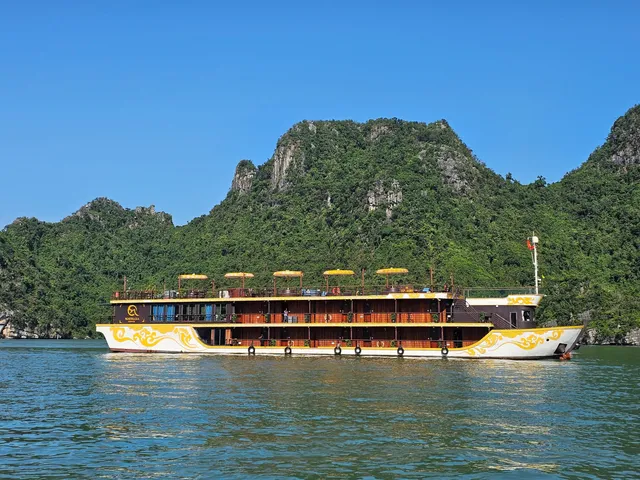
Peony Cruise
Cabins 20
Launched 2018
From$145per person, two sharingread 6 Aug 2026A guide, not a quote — we confirm the live rate when you enquire.
Details →We classified 6,966 guest reviews by subject and then looked only at the angry ones. The loudest complaint turns out not to be the one that marks a bad trip. Three quieter ones do, and all three are things a photograph will not show you and you can ask about before you pay.
halongtrip crew·Updated ·7 min read·Part of The Ha Long Bay cruise guide, from the data

Complaints are more useful than praise when you are choosing a boat, because praise clusters and complaints diverge. So we took the 6,966 reviews we had classified by subject, looked only at the one and two star ones, and asked what the unhappy guests actually raise. The answer has a twist in it. The subject they complain about most is not the subject that decides whether a trip went wrong.
| Subject | Share of 1–2 star reviews | Share of 5 star reviews |
|---|---|---|
| Food | 56% | 51% |
| Cleanliness | 34% | 11% |
| Money and worth | 31% | 5% |
| The itinerary going wrong | 29% | 1% |
| Paying extra on board | 28% | 2% |
| Booking and admin | 27% | 2% |
| The road transfer | 18% | 4% |
The right way to read this table is across the two columns, not down the first one. A subject only tells you something if it appears far more often in angry reviews than in happy ones. Food fails that test completely.
Food is raised in 56% of one and two star reviews. It is also raised in 51% of five star ones. That is a gap of five points, where each of the three subjects below opens a gap of more than twenty. Both the furious guests and the delighted ones came home talking about dinner, which means dinner did not decide which camp they landed in. Food is the loudest complaint and the least informative, because everyone mentions it regardless of how the trip went. If you are reading reviews to pick a boat, a grumble about the food is close to noise.
Three subjects behave the opposite way. Each appears in 27% to 29% of angry reviews and almost never in a happy one, and each stays invisible until you sail.
The itinerary going wrong shows up in 29% of one and two star reviews and 1% of five star ones, the sharpest split in the table. It covers a stop that did not happen, a slower or more crowded day than expected, a schedule that disappointed. One guest who took a three-day trip wrote simply that “The day 2 and 3 itenenary was pretty bad imo” (review). It is one guest’s opinion of their own days on the water, which is exactly what makes the pattern worth counting when thousands of them line up the same way.
Paying extra on board shows up in 28% of angry reviews and 2% of happy ones. The complaint is rarely that the extras exist; it is that they were a surprise. One guest on a three-day trip found that at the last brunch before disembarking “coffee and tea was an additional charge” (review), a charge that lands better when it is named before you book than when it appears at the end.
Booking and admin shows up in 27% of angry reviews and 2% of happy ones. This is the slow email, the reassignment, the refund that took chasing. One guest put it plainly: “The response speed to the email is slow, and I have been eagerly awaiting a reply for quite some time” (review).
Each of the three quotes above is one person describing their own trip, and none of them proves what any boat is generally like. That is the point of counting rather than cherry-picking. When a subject sits in more than a quarter of angry reviews and almost no happy ones, across thousands of trips, the pattern is real even though no single review settles anything. And all three patterns are answerable in advance: ask what happens if a stop is missed, ask for the full list of on-board charges, and test how fast the operator replies to your first email, because the speed of that reply is itself a preview.
The catch is that we count what guests wrote and do not judge who was right in any dispute. A review saying a stop was skipped and an operator who would say otherwise both exist, and this page takes neither side of a specific case. What it reports is frequency, not fault.
Two limits sit under the numbers. The subject labels are machine-assigned, scored at 89% precision and 84% recall, and money and booking both under-detect, so where this page says 31% of angry reviews raised worth, read it as at least 31%. And a review counts a small annoyance the same as a ruined trip: the table measures how often a subject comes up, not how much it hurt.
What do guests complain about most? Food, but it is the least useful complaint, because happy guests raise it just as often. The complaints worth weighing are cut itineraries, surprise charges and booking trouble.
Why does food not matter if everyone mentions it? Because it appears in 56% of angry reviews and 51% of happy ones. A subject only signals a bad trip when it is far more common among unhappy guests, and food is not.
Which complaint is the strongest warning sign? The itinerary going wrong, which appears in 29% of one and two star reviews and just 1% of five star ones. It is the sharpest divide in the whole table.
Can I avoid these problems by asking questions? Largely, yes. All three of the serious complaints are invisible in a photo but answerable in an email: ask about missed stops, on-board charges and how the schedule runs. Our guide to life on board covers the same pattern from the other side.
From$145per person, two sharingread 6 Aug 2026A guide, not a quote — we confirm the live rate when you enquire.
Details →From$155per person, two sharingread 6 Aug 2026A guide, not a quote — we confirm the live rate when you enquire.
Details →From$366per person, two sharingread 8 Oct 2026A guide, not a quote — we confirm the live rate when you enquire.
Details →Every boat advertises a jacuzzi, a kayak and a cooking class. We checked all 92 we publish, then read what 6,966 guests wrote afterwards. The things the brochures compete on turn out to be the things that never vary.
MoneyThirty-six Ha Long operators print their own cancellation ladder. The free window runs from 72 hours to 45 days before departure, cheap rates are often non-refundable, and a bay closure has rules of its own.