HL-02 · Ha Long Bay
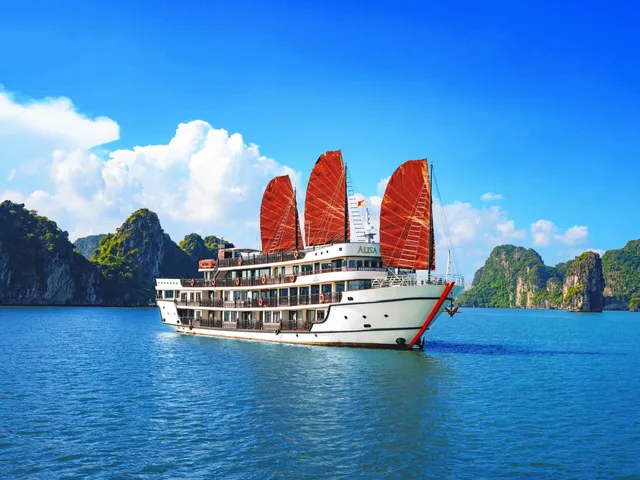
Alisa Premier Cruise
Cabins 22
Launched 2017
From$155per person, two sharingread 28 Oct 2026A guide, not a quote — we confirm the live rate when you enquire.
Details →Ha Long Bay has 1,969 islands over 1,553 km², by its management board's count. The World Heritage site is a different, smaller area: 775 islands in its Ha Long Bay zone before 2023, and 1,133 islands since the Cat Ba archipelago was added that year.
halongtrip crew·Updated ·8 min read·Part of Ha Long Bay vs Lan Ha vs Bai Tu Long: which to book
Ha Long Bay has 1,969 islands spread over 1,553 km², and 980 of them have names, according to the Ha Long Bay Management Board, the provincial body that runs the bay. The UNESCO World Heritage site is a different, smaller area. Before 2023 its zone in Ha Long Bay covered 434 km² and 775 islands, 411 of them named. Since the listing took in the Cat Ba archipelago to the south-west in 2023, it has covered 1,133 islands.
Our part is the boats. Of the 92 overnight boats we publish, counted on 20 November 2026, 31 sail Ha Long Bay itself, 46 sail Lan Ha Bay among the Cat Ba islands, and 15 sail Bai Tu Long. Our bay comparison covers how those three routes differ. This page covers the bay they share: its size, its listing, its rock, its water and its name.
There are 1,969 islands in Ha Long Bay as a whole. The other two figures belong to the World Heritage site, a different and smaller area: 434 km² of Ha Long Bay before 2023, and 656.5 km² across Ha Long Bay and the Cat Ba archipelago since.
| Count | What it covers | Area | Of which |
|---|---|---|---|
| 1,969 islands | Ha Long Bay as a whole, in Quang Ninh province | 1,553 km² | 980 named |
| 775 islands | The World Heritage zone in Ha Long Bay before 2023 | 434 km² | 411 named |
| 1,133 islands | The enlarged heritage site, renamed Ha Long Bay - Cat Ba Archipelago in 2023 | 656.5 km² | 775 in Ha Long Bay, 358 in the Cat Ba archipelago |
Source: Ha Long Bay Management Board; UNESCO’s own entry gives the same 1,133 islands and 65,650 hectares, which is 656.5 km².
More than nine in ten of the islands are limestone, rising between 50 and 200 metres out of the water. The rest are earth islands, with soil, thick vegetation and, on some of them, people and animals living there. On its northern side the bay runs along the Quang Ninh coast from Ha An and Tuan Chau through Bai Chay and Hon Gai to the Van Don special zone, which puts the harbour that 68 of our 92 boats leave from, Tuan Chau, on its edge.
On 17 December 1994. The World Heritage Committee, meeting for its 18th session in Phuket, Thailand, listed Ha Long Bay for its scenery under criterion (vii). Six years later, on 2 December 2000, at the 24th session in Cairns, Australia, the committee recognised it a second time under criterion (viii), for its geology and landforms.
The third decision came on 16 September 2023, at the 45th session in Riyadh. The committee extended the boundary south-west to Hai Phong’s Cat Ba archipelago, and the site has been listed as Ha Long Bay - Cat Ba Archipelago since. The management board notes that it became the first World Heritage site in Vietnam to lie across two provinces. UNESCO now gives the property as 65,650 hectares with a buffer zone of 34,140 hectares around it. Cat Ba already had its own UNESCO status, as a Biosphere Reserve since 2004, and had been a national park since 1986.
Vietnam’s own protection came first. Ha Long Bay was made a national scenic site in 1962, covering the full 1,553 km², and a Special National Monument on 12 August 2009, by Decision 1272/QĐ-TTg of the Prime Minister. On 25 August 2024 the International Union of Geological Sciences added Ha Long Bay - Cat Ba Archipelago to its list of geological heritage sites.
For a cruise, the 2023 change is the one that matters. Lan Ha Bay, where 46 of the 92 boats we publish sail, lies among the Cat Ba islands that the listing took in. Before then the site stopped at the Quang Ninh side.
It holds a “New 7 Wonders of Nature” title, and that title comes from a privately run vote. The management board records that New Open World, which ran the campaign, presented the award at My Dinh Stadium in Hanoi on 27 April 2012. That title has no connection to the UNESCO listing, which is a decision of the intergovernmental World Heritage Committee under the World Heritage Convention, made in 1994 and revisited in 2000 and 2023.
Ha Long Bay is limestone country that the sea has flooded, drained and flooded again. The management board describes a layer of limestone about 1,000 metres thick, worn by a hot, wet climate while the land rose slowly, and then invaded by the sea several times over. Part of that landscape is still under water today. The geological record behind it is clear for nearly 500 million years, according to both the board and Vietnam’s Department of Cultural Heritage.
UNESCO calls the result the most extensive example of marine-invaded tower karst anywhere in the world. It singles out two shapes: fengcong, clusters of cone-shaped peaks, and fenglin, towers standing on their own. When the sea rose again in the late Pleistocene and the Holocene it drowned the hollows between the peaks, which is where the enclosed saltwater lakes come from, and it cut a groove into the foot of the limestone islands. Look for that notch at the waterline from the deck. The board also points out old sea levels recorded by oyster and barnacle marks on the cliffs, and fossil coral colonies of the Syringoporida group dating from the Early Carboniferous.
The management board sorts the bay’s caves into three kinds.
| Kind of cave | How it formed | One you can reach by boat |
|---|---|---|
| Ancient underground cave | Left from old underground river systems, now high in the rock, steep inside, often full of stalactites | Sung Sot Cave |
| Karst-foot cave | Cut sideways at an old base level, with a wide floor sitting a little above today’s sea | Trinh Nu Cave |
| Sea-notch cave | Worn into the foot of an island by waves and tide; some go right through and become tunnels | Luon Cave |
Most Ha Long boats show you the first kind: Sung Sot is on 28 of the 31 Ha Long boats we publish, by our stop count of 16 October 2026. Luon, the sea-notch tunnel, is on 19. Alisa Premier, the best-rated Ha Long boat in our ranking at 87.7% five-star across 1,541 reviews (14 November 2026), has one cave of each kind on its stop list: Sung Sot, Trinh Nu and Luon. The caves and islands guide counts every stop by bay.
Shallow. The management board gives an average depth of 5 to 10 metres over a fairly flat seabed, with a few channels averaging 15 to 29 metres. The tide comes in once and goes out once a day, and the board puts the tidal range between 1.9 and 4.6 metres. Tides run lower in March, April, August and September and higher in January, June, July and December. The water is saltier in the dry season, 32 to 33 parts per thousand, than in the rains, when it drops to 21 or 22.
The catch is that a few metres of tide decide what you can do at some stops. At Three Peaches Beach in Lan Ha, operators say the sand is only above water for two or three hours a day. Ask your boat what the tide will be doing when it gets there. For how much the boat itself moves, our guide to seasickness on Ha Long Bay has four years of modelled wave data.
Ha Long means “descending dragon”. The management board tells the legend this way. When the Vietnamese were first founding their country and invaders came by sea, heaven sent a mother dragon and her young to help. They spat out jewels that turned into a wall of stone islands, and the enemy ships broke against them. The dragons stayed. Where the mother came down is Ha Long; where her young came down is Bai Tu Long, the bay that 15 of our boats sail; and the white water their tails threw up is Long Vi, the Tra Co peninsula at Mong Cai.
Before the 19th century, Vietnamese records knew these waters by other names, among them Giao Chau, Luc Thuy, An Bang and Hai Dong. “Ha Long” turns up on French nautical charts of the Gulf of Tonkin at the end of the 1800s. In 1898, the board recounts, a French lieutenant commanding the Avalanche reported that he and many of his crew had seen a pair of giant sea serpents in the bay, and a French-language paper in Hai Phong ran the story as a dragon appearing in Ha Long Bay.
One island name has a precise date. Ti Top was called Cat Nang before Ho Chi Minh visited it on 22 January 1962 with Gherman Titov, the Soviet cosmonaut, and proposed naming it after him. Of the 411 named islands in the heritage zone, the board says, it is the only one named after a foreigner with a documented origin. The same board page says Ti Top takes about two-thirds of everyone who visits Ha Long Bay each year, and 29 of our 31 Ha Long boats stop there. Our Ti Top Island guide lists the seven that go in the morning.
Indochine, Kong: Skull Island and The Creator, according to the Vietnamese press. Indochine, the French film by Régis Wargnier first shown in 1992, has many scenes shot on the bay and went on to win an Oscar; Bao Quang Ninh, the provincial paper, credits it with a jump in European, and above all French, visitors. Kong: Skull Island brought its equipment to the Tuan Chau passenger port in March 2016 and filmed around Coc Cheo islet. Its director, Jordan Vogt-Roberts, flew back in by seaplane in May 2017 to film a television programme. In 2023 Gareth Edwards’s The Creator used Ha Long Bay as a setting, Nhan Dan reported.
Vietnam’s Department of Cultural Heritage, writing on the 2023 listing, counts 4,910 species of plants and animals on land and in the sea across Ha Long Bay and Cat Ba, 198 of them on the IUCN Red List and 51 endemic. It lists seven ecosystems, from primary rainforest on Cat Ba to mangroves, tidal flats, coral reefs and the saltwater lakes inside the islands.
UNESCO’s entry names several of them. The Cat Ba langur, a primate that lives only in the archipelago, is Critically Endangered, and UNESCO says the small population is still disturbed by tourism. The others it lists are the Ha Long palm (Livistona halongensis), the Cat Ba tiger gecko, the keeled box turtle, the Asian small-clawed otter, the mainland serow and the king cobra.
Is Ha Long Bay on UNESCO’s list? Yes, since 17 December 1994, when the World Heritage Committee listed it for its scenery. It was recognised again on 2 December 2000 for its geology. Since 16 September 2023 the site has also taken in Hai Phong’s Cat Ba archipelago, and its name on the list is Ha Long Bay - Cat Ba Archipelago. Lan Ha Bay, where 46 of the 92 boats we publish sail, lies among those Cat Ba islands.
How many islands does Ha Long Bay have? 1,969, across 1,553 km², on the count kept by the bay’s management board, of which 980 are named. Figures of 775 and 1,133 refer to the World Heritage site: 775 islands in the Ha Long Bay zone before 2023, and 1,133 once the 358 islands of the Cat Ba archipelago were added in 2023.
How old is Ha Long Bay? The rock has a clear geological record of nearly 500 million years, according to the bay’s management board and Vietnam’s Department of Cultural Heritage. The seascape you sail through is much more recent: the board dates the sea’s flooding of the limestone, which cut the notches and the caves at the waterline, to the late Pleistocene and the Holocene.
Can you swim in Ha Long Bay? Yes. On 56 of the 92 boats we publish, read on 20 November 2026, the one-night programme includes a swim. Tide decides the timing at some beaches. Our guide to swimming in Ha Long Bay covers which stops have a swim and in which months the sea is warm enough.
From$155per person, two sharingread 28 Oct 2026A guide, not a quote — we confirm the live rate when you enquire.
Details →From$366per person, two sharingread 28 Oct 2026A guide, not a quote — we confirm the live rate when you enquire.
Details →From$130per person, two sharingread 28 Oct 2026A guide, not a quote — we confirm the live rate when you enquire.
Details →Three names, one body of water, and a decision most people make by accident. What actually differs between them, from the itineraries of the 92 boats we publish.
What you will seeBrochures name a dozen wonders. The itineraries of the 92 boats we publish name far fewer, and the same handful keeps coming round. Here is what a ticket really buys you.
What you will seeTwenty-nine of the 31 Ha Long boats we publish stop at Ti Top, so you will almost certainly climb its steps or swim off its beach. The choice that changes the visit is the hour, and only seven boats go in the morning.
What you will seeLuon is a low tunnel through the foot of an island into a lake walled by cliffs, and you go through it by kayak or in a rowed bamboo boat. We list every boat that goes in, the hour it does, and which of the two boats costs extra.
What you will seeSung Sot is the cave on the postcards, and it is a Ha Long Bay stop only. Twenty-eight of the thirty-one Ha Long boats we publish stop there. Choosing it means choosing the busiest water in the bay, and the reviews are clear about why.
Life on boardProbably not. Across four years of modelled sea data the highest wave of a typical day on the open water off Ha Long was 0.38 m, and only 7 of 11,497 written guest reviews describe feeling unwell on the boat. The motion people do notice comes in the tender and the first hour under way.